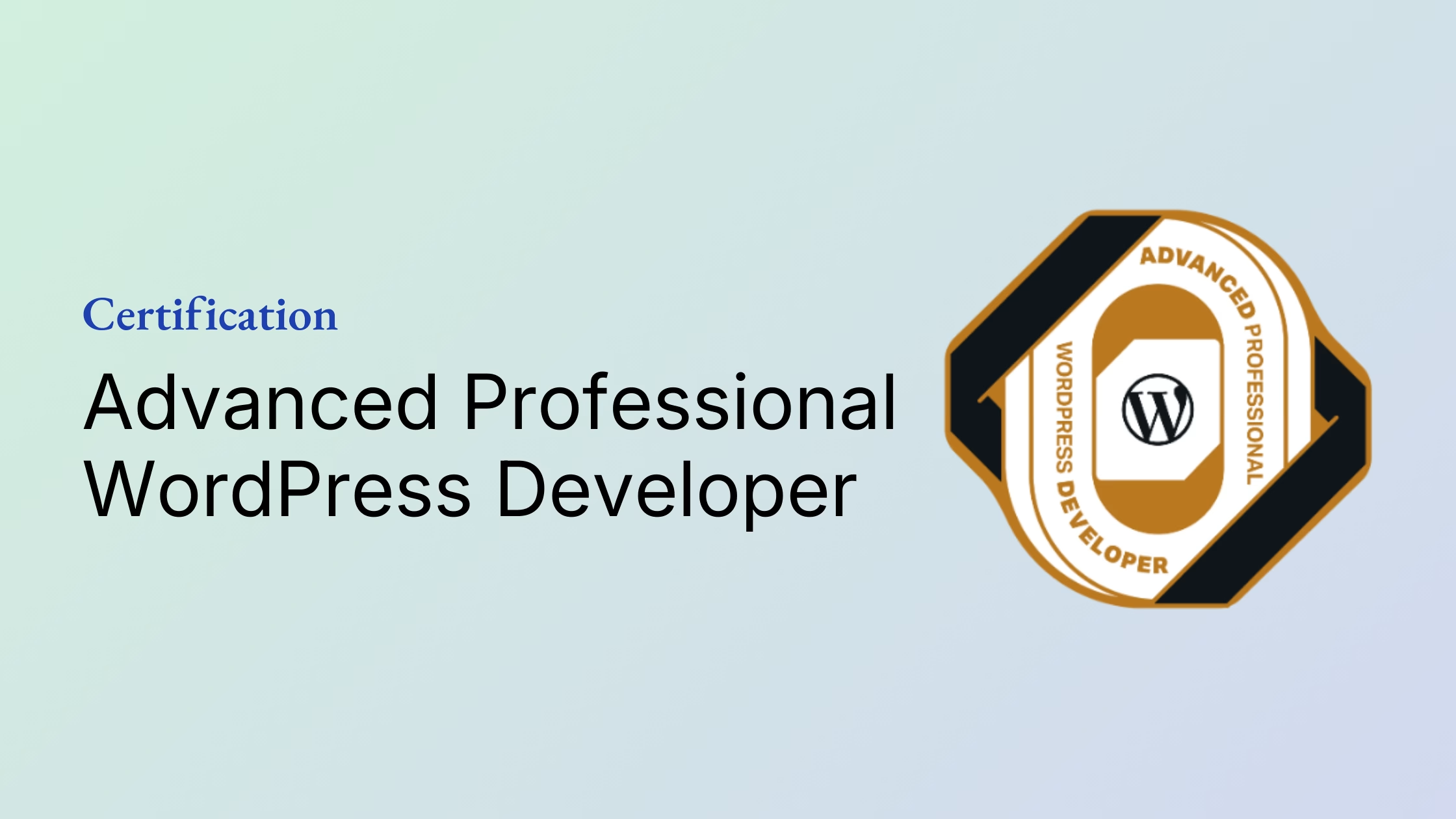
I have successfully passed the Advanced Professional WordPress Developer Certification provided by WPVIP (WordPress VIP).
This is a proctored, enterprise‑level certification that validates deep expertise in WordPress architecture, performance engineering, security posture, and long‑term reliability principles. It is not a surface‑level assessment. It evaluates applied knowledge of how WordPress behaves as business‑critical infrastructure under scale, complexity, and operational pressure.
This article is not about personal achievement. It is about what this certification means for organizations running WordPress as a revenue‑impacting system and how it strengthens the engineering discipline behind every audit I conduct.
What Is WPVIP?
WPVIP (WordPress VIP) is Automattic’s enterprise WordPress platform designed for high‑traffic publishers, large organizations, and mission‑critical digital properties. It is built around strict coding standards, performance discipline, security hardening, and operational reliability.
Organizations running on WPVIP typically operate at significant scale. That scale demands:
- Predictable performance under traffic spikes
- Structured deployment practices
- Safe architectural evolution
- Strong security posture
- Maintainable code and plugin discipline
The ecosystem is not optimized for experimentation or shortcuts. It is optimized for stability, longevity, and operational confidence.
Understanding these standards changes how one evaluates WordPress systems, even outside the WordPress VIP platform itself.
What the Advanced Professional WordPress Developer Certification Evaluates
The Advanced Professional WordPress Developer Certification is not a beginner-level validation. It assesses applied understanding across areas that directly impact enterprise WordPress systems. These areas are interconnected. Weakness in one typically exposes fragility in another.
1. Architecture and System Design
Enterprise WordPress platforms are not single-layer applications. They are ecosystems consisting of themes, plugins, custom integrations, external APIs, caching layers, database structures, and hosting configurations.
This certification evaluates whether a developer understands:
- How architectural coupling creates long-term fragility
- Where single points of failure exist within WordPress systems
- How custom post types, taxonomies, and meta structures affect scalability
- How integration layers influence maintainability and upgrade safety
- When to extend WordPress versus when to isolate functionality
At scale, poor architecture does not fail immediately. It degrades gradually. The certification validates the ability to identify and avoid those slow-failure patterns before they become operational incidents.
2. Coding Standards and Quality Discipline
Enterprise WordPress development requires more than functional code. It requires predictable, maintainable, and secure code.
This includes understanding and applying:
- WordPress Coding Standards
- Secure data handling and sanitization practices
- Proper escaping and output discipline
- Clear separation of concerns in theme and plugin development
- Maintainable file and namespace structures
In high-scale environments, inconsistent coding patterns increase regression risk during updates and team transitions. The certification reinforces disciplined implementation practices that reduce technical debt accumulation.
3. Performance Principles
Performance at enterprise scale is not about isolated PageSpeed scores. It is about system behavior under real-world load conditions.
The certification evaluates understanding of:
- Query optimization and database access patterns
- Object caching and persistent cache strategies
- Asset loading discipline and dependency management
- How WordPress hooks and filters influence execution cost
- Admin-side performance and operational overhead
Many WordPress systems appear stable until traffic spikes or integration complexity increases. Performance principles validated here focus on resilience, not cosmetic speed optimization.
4. Security Posture
Enterprise WordPress platforms must assume exposure. Security is not reactive. It is architectural.
The certification reinforces understanding of:
- Secure configuration defaults
- Role and capability management
- Secure authentication flows
- Dependency hygiene and update discipline
- Minimizing attack surface through controlled extensibility
Security failures in enterprise environments have financial and reputational consequences. The certification emphasizes structural security thinking rather than reliance on plugin-based protection alone.
5. Operational Reliability
WordPress systems evolve continuously. Themes change. Plugins update. Integrations expand. Traffic fluctuates.
Operational reliability evaluates whether a developer understands:
- Deployment and rollback safety
- Upgrade risk modeling
- Integration failure containment
- Observability and monitoring considerations
- How architectural decisions affect long-term operational confidence
Reliable systems are not defined by uptime alone. They are defined by how safely they adapt to change. The certification validates an understanding of these dynamics.
Because the certification is proctored, it reinforces genuine applied knowledge rather than assisted responses or surface familiarity.
Why This Matters for Enterprise WordPress Teams
Many WordPress sites perform adequately at small or moderate scale. The real problems appear when:
- Traffic increases significantly
- Integrations accumulate
- Feature velocity accelerates
- Teams grow and handoffs multiply
- Business dependence on WordPress deepens
At that stage, architectural shortcuts compound. Performance degradation becomes unpredictable. Updates become risky. Technical debt becomes expensive.
The standards validated by this certification focus on preventing those scenarios.
For enterprise teams, this translates into:
- Reduced regression risk during updates
- More predictable performance under growth
- Safer architectural evolution
- Clearer separation of concerns in system design
- Lower long‑term maintenance friction
It reinforces a systems‑engineering mindset rather than a feature‑delivery mindset.
How This Strengthens My Audit Methodology
This certification does not change my positioning. It reinforces it.
As an Enterprise WordPress Engineer, my focus has been on diagnosing and stabilizing business‑critical WordPress platforms through structured audits.
The principles validated through the Advanced Professional WordPress Developer Certification are embedded directly into:
- WordPress Readiness & Risk Assessment Audit
- WordPress Performance Audit
- WordPress Technical Architecture & Reliability Audit
When evaluating a system, I assess:
- Architectural coupling and fragility
- Query behavior and performance exposure
- Cache and infrastructure discipline
- Code maintainability signals
- Security and configuration posture
- Operational resilience under change
This certification provides external validation that these evaluations align with enterprise WordPress standards.
What This Means Going Forward
WordPress powers a significant portion of the web. But not all WordPress systems are built with enterprise discipline.
If your platform supports revenue, product delivery, publishing at scale, or business‑critical operations, informal optimization is not enough. Structured evaluation and risk prioritization are essential.
The Advanced Professional WordPress Developer Certification reinforces the standards applied in every diagnostic engagement I conduct.
If you are unsure where your WordPress platform stands in terms of readiness, reliability, and risk exposure, start with a structured assessment.
- WordPress Readiness & Risk Assessment Audit
- WordPress Performance Audit
- WordPress Technical Architecture & Reliability Audit
Enterprise WordPress systems require engineering discipline. That discipline is now externally validated and continuously applied.
Frequently Asked Questions
Yes. While it is provided by WPVIP, the principles it validates are architecture discipline, performance awareness, secure coding, and reliability thinking which is applied to any serious WordPress platform, whether hosted on WPVIP or elsewhere.
It reinforces and validates the standards already applied. The audit methodology aligns with enterprise WordPress best practices, focusing on structural risk, scalability constraints, and operational resilience.
It increases confidence that architectural decisions, performance evaluations, and reliability assessments are grounded in standards expected at enterprise scale, not ad‑hoc optimization tactics.
Final Thoughts
If your WordPress platform is business‑critical, the next step is clarity. Not more plugins, not reactive fixes, but structured diagnosis.
If you are preparing for growth, high‑traffic launches, migrations, architectural changes, or simply want confidence in your current foundation, start with a structured evaluation.
High‑scale WordPress systems do not fail because of features. They fail because of architectural fragility and unmanaged risk. Identify those risks before they become outages.